
Water Heater Repair and Replacement in Austin
Tank or tankless, gas or electric: what can be repaired, when to replace and how to size the new one.
Many water heater problems are repairs: a thermocouple or gas valve on a gas tank, a burned-out element or thermostat on an electric one, a relief valve that drips, a drain valve that will not close. Replacement makes sense when the tank itself leaks, when the heater is near the end of its expected life and needs an expensive part, or when it no longer keeps up with the household. A leak from the tank body cannot be repaired.
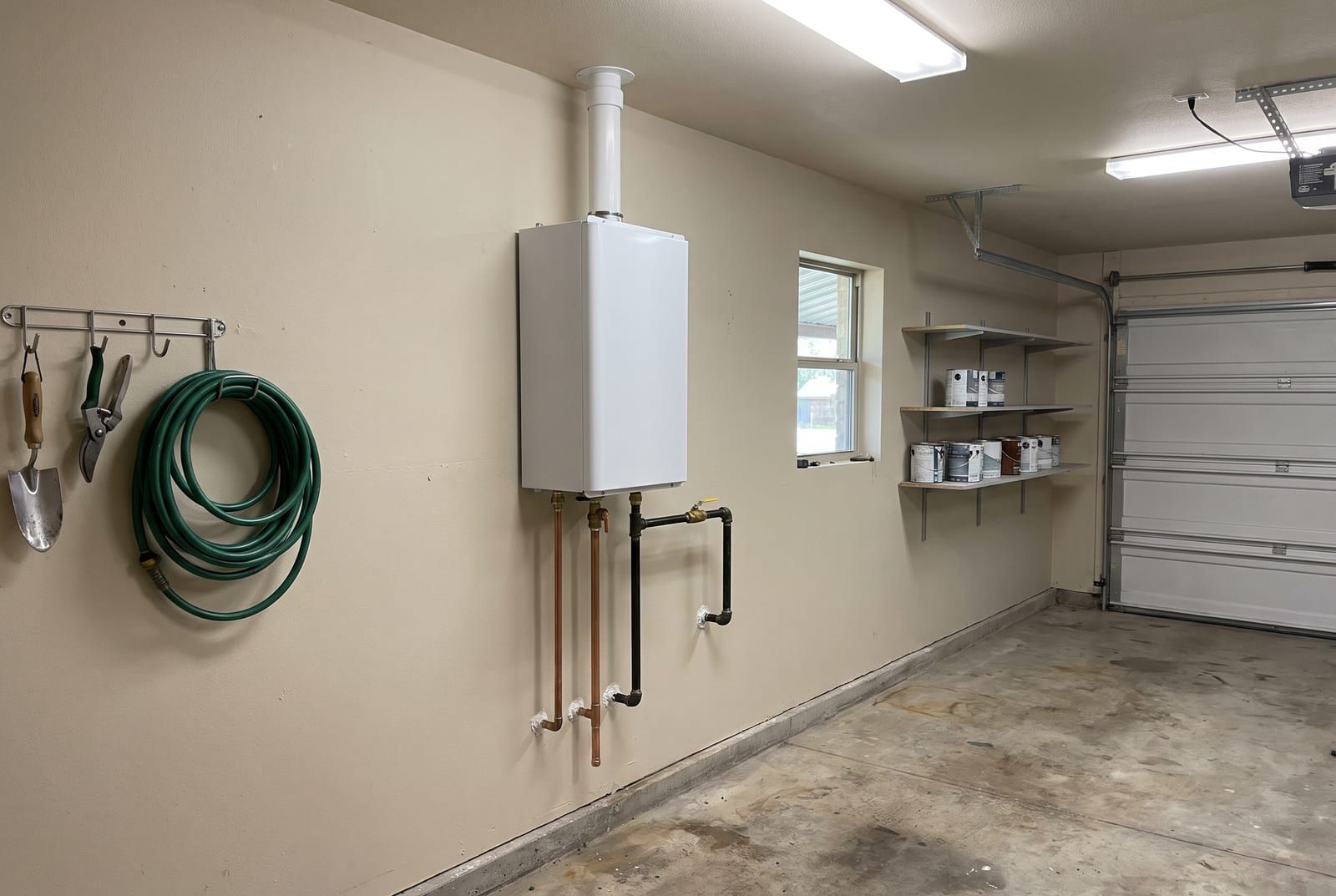
Tank, Tankless, Gas or Electric
The right type depends on the fuel already in the house, where the heater sits and how the household uses hot water. Switching types is possible, but moving from a tank to a gas tankless unit usually means a bigger gas line and new venting.
| Type | How it works | Suits | Limits |
|---|---|---|---|
| Gas tank | A burner under a 40 to 50 gallon tank keeps water hot and ready; the flue carries exhaust up through the roof. | Most Austin houses with a gas line; families who use a lot of water at once. | Hot water runs out when the tank is drained; scale settles in the bottom and shortens its life. |
| Electric tank | Two heating elements inside the tank warm the water; no flue or gas line needed. | Houses without gas, closets and spots where venting is hard. | Slower to recover after a long shower; elements scale up and burn out in hard water. |
| Gas tankless | A burner heats water only while a tap is open, moving it through a heat exchanger. | Households that want endless hot water and the wall space it frees up. | Needs a larger gas line and a dedicated vent; the heat exchanger needs descaling in hard water. |
| Electric tankless | Heating elements warm water as it flows, sized by how many gallons a minute it must heat. | Small homes, additions and single bathrooms. | Whole-house units draw heavy electrical current, often more than an older panel can supply. |
Hard Water and Scale
Central Texas water carries a lot of dissolved minerals. When it is heated, those minerals drop out as scale: a crust on the bottom of a tank, on electric elements and inside the narrow passages of a tankless heat exchanger. Scale insulates the water from the burner, so the heater works longer for the same hot water, and it is the usual reason a tank starts to rumble. A little maintenance keeps it in check:
- Flush the tank once a year: shut off the burner or the power, run a hose from the drain valve to a floor drain or outside, and drain until the water runs clear.
- Descale a tankless unit on the maker’s schedule by circulating a descaling solution through the service valves.
- Lift the relief valve lever briefly once a year to make sure it opens and closes.
- Look at the base of the tank and the pan for moisture or rust every few months.
- Keep the thermostat near 120°F, which slows scale and lowers the risk of scalding.
Garage and Attic Installations
Austin houses often have the water heater in the garage, raised on a platform so the burner sits above any gasoline fumes, or up in the attic where it takes no floor space. Both locations bring their own rules. An attic or upstairs heater needs a drain pan with a line that carries water somewhere visible, because a slow leak there ends up in the ceiling below. A gas heater needs its vent run correctly to the roof and enough air to burn, and the relief valve discharge has to run down to a safe point. Replacing a heater in either spot is the time to check the pan, the vent and the relief line as well.
Size the Next Water Heater
Water Heater Sizing Guide
Pick the household and the type, then press the button for a starting size.
Choose the household and the type, then press the button.
Water Heater Questions
What are the signs a water heater is failing?
Rust-colored hot water, a rumbling or popping tank, water pooling at the base, hot water that runs out sooner than it used to, and a pilot or burner that keeps going out. Moisture at the base of a tank is the one to act on quickly: a tank that weeps usually fails completely soon after.
How often should a tank be flushed in Austin?
Once a year is a sensible habit with Austin’s hard water. Flushing drains the scale and sediment that settle on the bottom of the tank, which is what makes a gas tank rumble and an electric element burn out. A tank that has never been flushed in many years can clog its drain valve with scale, so the first flush is best done with someone who can handle that.
Does replacing a water heater need a permit?
In the City of Austin a water heater replacement is permitted work, followed by an inspection of the venting, the gas connection, the relief valve discharge and the pan. Cities around Austin have their own rules. Ask about the permit when you book and it will be part of the plan for the job.
Why would a new heater need an expansion tank?
Water expands as it heats. In a house with a pressure regulator or a check valve at the meter, that extra volume has nowhere to go, and pressure spikes every time the burner runs. A small expansion tank on the cold line absorbs it, which protects the relief valve, the fixtures and the tank itself.
Tank or tankless: which lasts longer?
A tankless heater that is descaled on schedule usually outlasts a tank, because it has no tank to rust through. In hard water it needs that maintenance, though, or scale builds up in the heat exchanger and the unit starts shutting down. A tank costs less to put in and is simpler to service.