
Whole-House and Partial Repiping in Austin
When corroded or leaking supply lines keep failing, replacing them costs less than chasing one leak after another.
A single leak gets a repair. The case for repiping builds when the leaks come one after another, when the water runs brown, or when the pressure has slowly dropped because the inside of the pipe is closing up with rust and scale. At that point each repair buys a few months until the next weak spot lets go, and the water damage from each one adds up. Replacing the supply lines, all of them or the worst runs, ends that cycle.
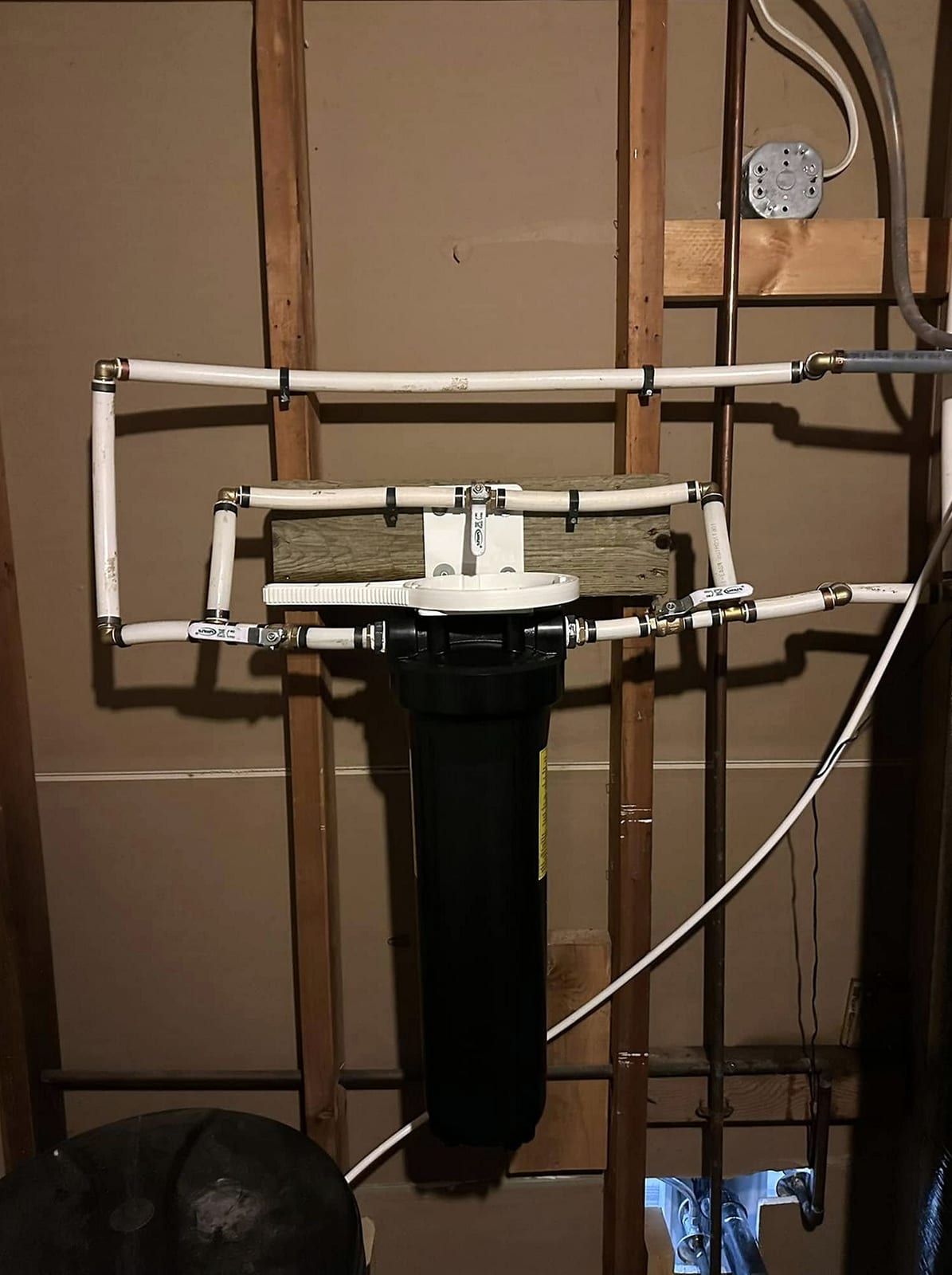
PEX, Copper and CPVC
Three materials cover nearly every repipe. The choice depends on the house, how the lines will be routed and what is already there.
| Material | Where it is used | Strengths | Limits | Fit with hard Central Texas water |
|---|---|---|---|---|
| PEX | Most whole-house repipes; runs fished through walls and attics | Flexible, few fittings, holds up to freezing better than rigid pipe | Cannot be left in sunlight; needs its own fittings and supports | Good: scale builds up slowly on its smooth wall |
| Copper | Exposed runs, water heater connections, partial repairs in copper houses | Long record, handles heat well, rigid and neat where it shows | More labor to install; can pinhole where water chemistry or flow wears it | Fair: scale lines it over time, and pinholes show up in some homes |
| CPVC | Some newer homes and repairs that tie into existing CPVC | Rigid, does not corrode, glued joints | Turns brittle with age and heat; joints can crack when disturbed | Good against scale, but older CPVC is fragile to work around |
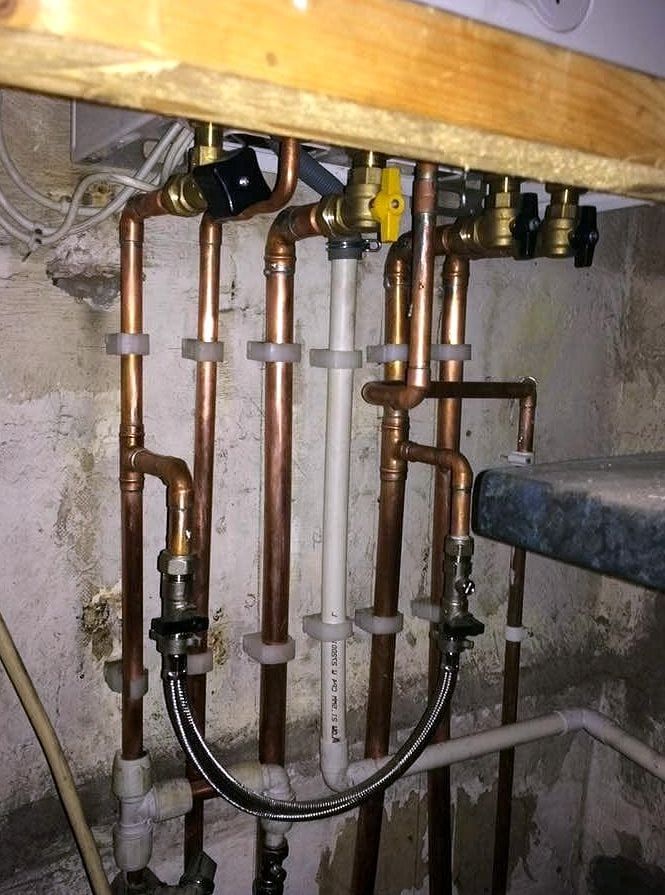
Copper is still the material of choice where pipe runs in the open, as in this set of lines with their own shut-off valves. In Austin’s hard water it collects scale inside like any metal pipe, and where water chemistry is aggressive it can develop pinholes over the years.
Signs a House Needs Repiping
- Pinhole leaks that keep appearing in different places.
- Brown, rusty or cloudy water, worst first thing in the morning.
- Low pressure at several fixtures that has crept down over the years.
- Galvanized steel supply pipe, common in houses built before the 1970s.
- Gray polybutylene pipe, used in some houses from the late 1970s into the 1990s.
- A slab line that has leaked more than once.
What Shapes the Size of a Repipe
No two repipes are the same amount of work. Tick what applies to your house to see how each factor changes the scope.
Repipe Scope Explainer
Choose the foundation and tick the factors that fit your house.
Pick the foundation, tick the factors, then press the button.
Repiping Questions
Can we live in the house while it is repiped?
In most cases, yes. The new lines are run while the old ones keep working, and the water is shut off only for the hours it takes to switch fixtures over to the new pipe. On a whole-house job, expect the water to be off for parts of some days, and plan laundry and showers around it.
How much drywall gets opened?
Only what is needed to reach the pipe: usually small cuts near each fixture and where lines cross a wall. PEX can often be fished through walls from the attic, which keeps the openings few. In a slab house, rerouting through the attic avoids breaking the floor at all.
Who patches the walls afterwards?
Ask about drywall when you book. Some homeowners have their own drywall and paint contractor; either way, the openings are left clean and square so the patch goes in easily.
Do we have to replace every pipe at once?
No. A partial repipe, replacing the worst runs such as the slab lines or the lines to one bathroom, is common when the rest of the system is in good shape. A full repipe makes more sense when the whole house is the same failing material.